Practical Binary Analysis: Reversing the Oracle
I’ve decided to take a break and approach Flag 8 another time, as it appears to be far more of a challenge than I originally anticipated, involving getting into the weeds with steganography and file representation. Instead, I wanted to make a post about something related but not directly in the scope of this CTF. Namely, I wanted to reverse engineer the oracle program to understand the details of how it generates each level and how it verifies each level’s flag.
Decompilation and Static Analysis
Lets start our efforts by checking to see if there are any interesting strings in the binary
1
2
3
4
5
6
7
8
9
10
11
12
13
14
15
16
17
18
19
20
21
22
23
24
25
26
27
28
29
30
31
32
33
34
35
36
37
38
39
40
41
42
43
44
45
46
47
48
49
50
51
52
53
54
55
56
57
58
59
60
61
62
63
64
65
66
67
68
69
70
71
72
73
74
75
76
77
78
79
80
81
82
83
84
85
86
87
88
89
90
91
92
93
94
95
96
97
98
99
100
101
kishoreg@kishoreg-G3-3779:~/Desktop/pba/oracle_extract$ strings oracle
/lib64/ld-linux-x86-64.so.2
libcrypto.so.1.0.0
_ITM_deregisterTMCloneTable
__gmon_start__
_Jv_RegisterClasses
_ITM_registerTMCloneTable
BIO_ctrl
BIO_write
BIO_push
BIO_set_flags
BIO_read
BIO_free_all
BIO_new
BIO_s_mem
BIO_new_mem_buf
BIO_f_base64
libcrypt.so.1
crypt
libc.so.6
__printf_chk
fopen
puts
__stack_chk_fail
fgets
strlen
__fprintf_chk
memcpy
fclose
stderr
fwrite
strcmp
__libc_start_main
OPENSSL_1.0.0
GLIBC_2.14
GLIBC_2.4
GLIBC_2.2.5
GLIBC_2.3.4
UH-@!`
AWAVI
AUATLc
[]A\A]A^A_
AWAV
AUAT
[]A\A]A^A_
AWAVAUATA
[]A\A]A^A_
AWAVA
AUATL
[]A\A]A^A_
$1$pba
levels.db
Failed to open %s
Base64 decode failed
Level exceeds maximum size
Failed to write %s
Usage: %s <flag> [-h]
Invalid flag: %s
$1$pba$cC.J56kTHt0f2BeCmPY0S0
$1$pba$ThmQr44j/SzgLnGGr3z0t.
$1$pba$bVbBZVMYF.yq/D95S14hi/
$1$pba$eZVsO8xkHTfWXQJlVj3vF.
$1$pba$9dVFs3IW334QFtvvh1ZkF0
$1$pba$/DR3oJXK6fqvBgD4db3EJ0
$1$pba$KjeCu9tJUVtd24nC4g75L/
$1$pba$mMAAETuTP0ixunRdwG9PT0
+~~~~~~~~~~~~~~~~~~~~~~~~~~~~~~~~~~~~~~~~~~~+
| Level %d completed, unlocked %-12s |
Run oracle with -h to show a hint
Use the flag obtained in the previous level to unlock the next
-h: Show a hint for the level unlocked by the given <flag>
Failed to load levels, missing/corrupted level file?
Failed to unlock level, corrupted level file?
;*3$"
GCC: (Ubuntu 5.4.0-6ubuntu1~16.04.10) 5.4.0 20160609
.shstrtab
.interp
.note.ABI-tag
.note.gnu.build-id
.gnu.hash
.dynsym
.dynstr
.gnu.version
.gnu.version_r
.rela.dyn
.rela.plt
.init
.plt.got
.text
.fini
.rodata
.eh_frame_hdr
.eh_frame
.init_array
.fini_array
.jcr
.dynamic
.got.plt
.data
.bss
.comment
Some interesting things that pop out include what appear to be MD5-based Unix crypt() password hashes, with a salt.
First, lets throw our oracle binary into IDA and see if we can figure out what’s going on.
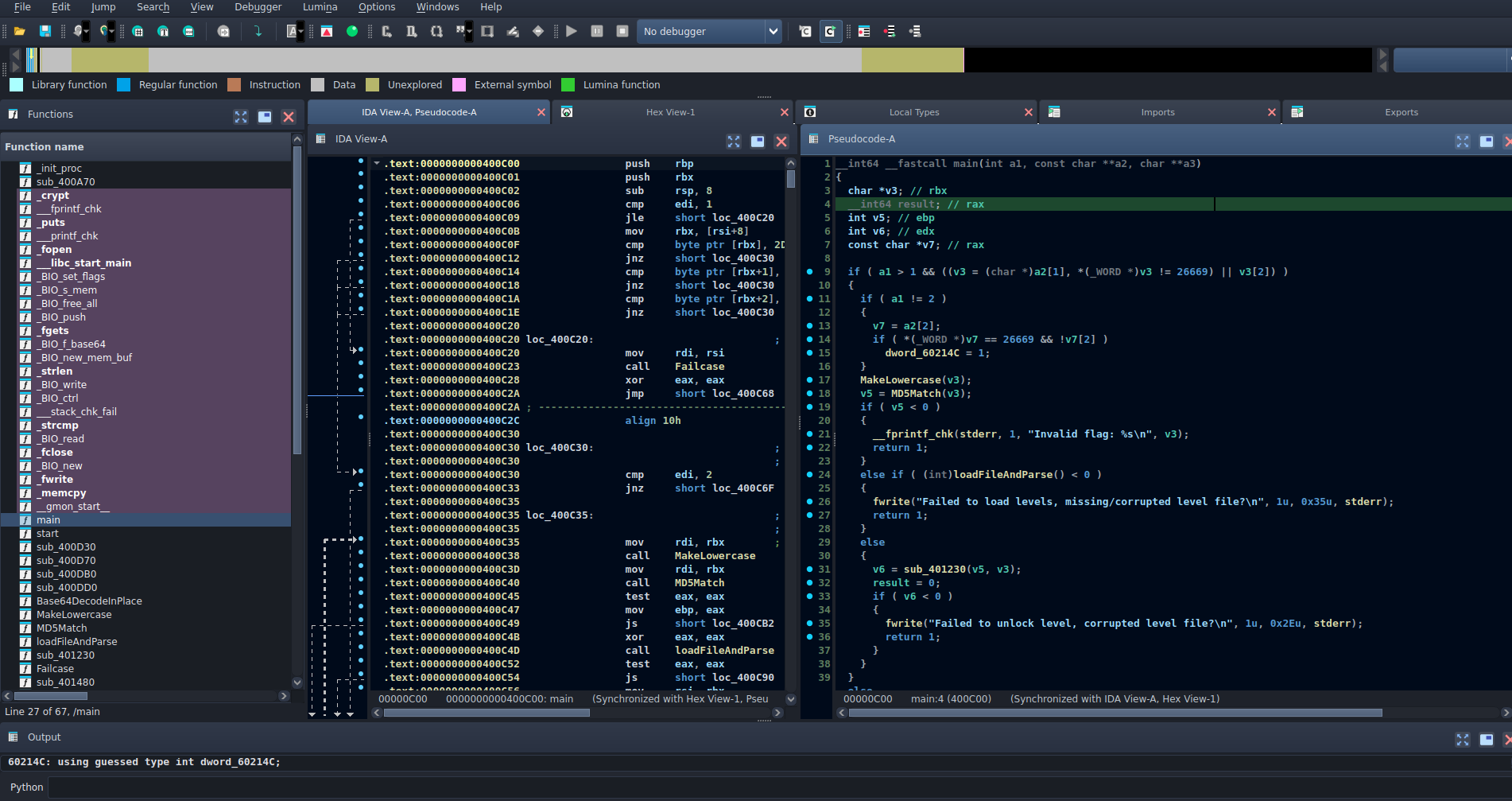
I renamed some function calls after determining what their intended purpose is. The main thing to see is that the flag user input is passed to a function I called MakeLowercase which merely makes any uppercase ASCII characters in the flag into lowercase. Next, it is passed to a function I determined was performing MD5 hash matching, so I named it MD5Match. Lets look a little deeper at this function
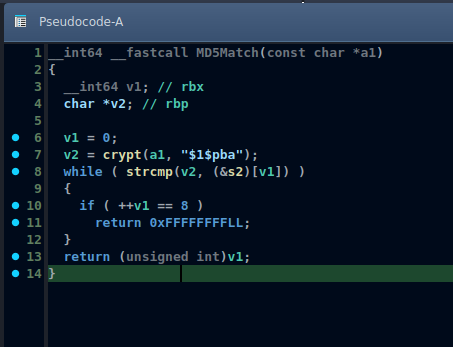
As we suspected earlier, it appears to use crypt() with the salt $1$pba to indicate an MD5-crypt hash calculation. This is compared to an array s2 which likely holds the hardcoded hashes we saw earlier to see if there are any matches. The index v1 is there to ensure we don’t go past 8, which is the total number of levels we have. On failure, this function return -1. Lets take a look at the .data section, which is where s2 resides.
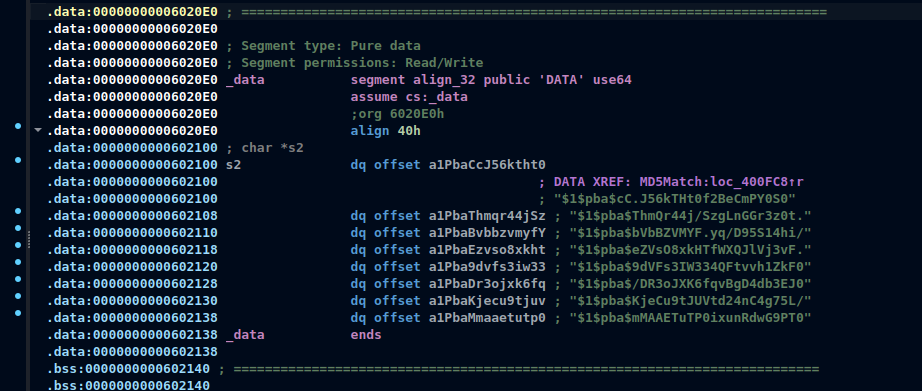
Here we can see all 8 hashes that are used for the comparison. Unfortunately, the only option to get a flag from one of these hashes and the salt alone is by bruteforce, and given that each password is 32 characters of randomly generated hex, we can’t feasibly use a dictionary attack either.