Practical Binary Analysis Ch. 5 CTF: Lvl 3

This post is my writeup detailing the solution to the Level 3 CTF challenge in the book Practical Binary Analysis. The previous writeup detailing the Level 1 and Level 2 flags can be found here.
Third Flag: lvl3
At this point, if you are following along, you should have captured the lvl2 flag from the previous writeup, which is

Next, lets take a look at the lvl3 binary itself. Giving it execute permissions and attempting to run it seems to fail as it doesn’t appear that the format of the ELF is designed to run on this machine. Maybe the file has corrupted fields in the executable header that we need to fix. Let’s throw it in readelf and see what we find
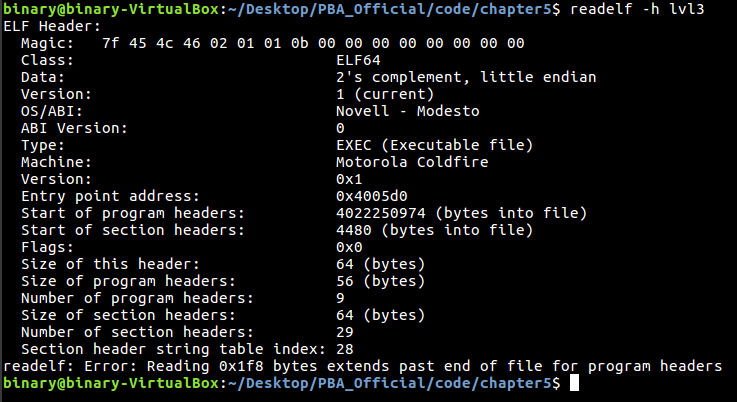
From the output it appears that some fields in the executable header are incorrect. Namely, the ABI, the Machine, and the program header table offset. These are three of the four broken things the hint told us to look for. Lets fix them one by one. For a 64-bit program, the executable header used is of type Elf64_Ehdr:
1
2
3
4
5
6
7
8
9
10
11
12
13
14
15
16
typedef struct {
    unsigned char e_ident[EI_NIDENT];
    uint16_t      e_type;
    uint16_t      e_machine;
    uint32_t      e_version;
    ElfN_Addr     e_entry;
    ElfN_Off      e_phoff;
    ElfN_Off      e_shoff;
    uint32_t      e_flags;
    uint16_t      e_ehsize;
    uint16_t      e_phentsize;
    uint16_t      e_phnum;
    uint16_t      e_shentsize;
    uint16_t      e_shnum;
    uint16_t      e_shstrndx;
} ElfN_Ehdr;
We can use the hexedit tool to modify specific bytes in the file. The first value we need to change is the EI_OSABI field in the executable header’s 16 byte e_ident array, which is at offset 8 in the file. In order to set it to the standard System V ABI, we need to set this byte to 0. We do something similar for the e_machine field at offset 18 in the executable header. According to the ELF specification, we need the value for EM_X86_64, which is 62, or 0x3E in hex. Setting these values now yields the following
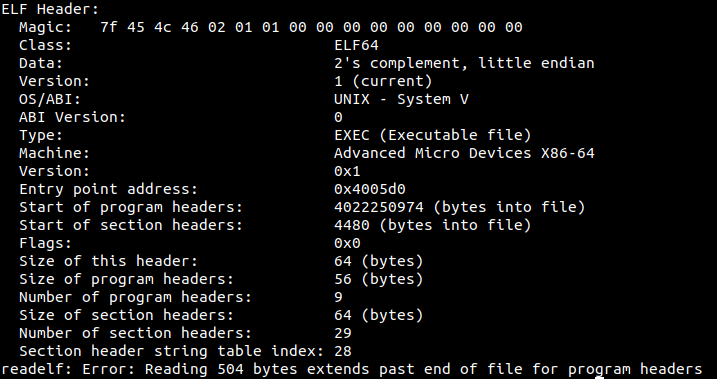
The e_phoff field is at offset 32 in the file and it appears the current value is corrupted to 0xDEADBEEF.

While the ELF specification makes no guarantees about the particular offset the program header table is to be located in the binary, we can often times assume it will appear right after the executable header. So lets try changing that 0xDEADBEEF to 0x40, to be right after the 64-byte executable header. And this seems to work! We are able to run the binary and retrieve a flag.

…or so we thought. Unfortunately it seems like a red-herring, and we’re going to have to fix one more thing before we get the correct flag. First, lets try to dump the code and see if anything stands out

Strange. It appears there is no code disassembled in the .text section. Why not? Let’s see the section header flags of all the sections to see what’s going on
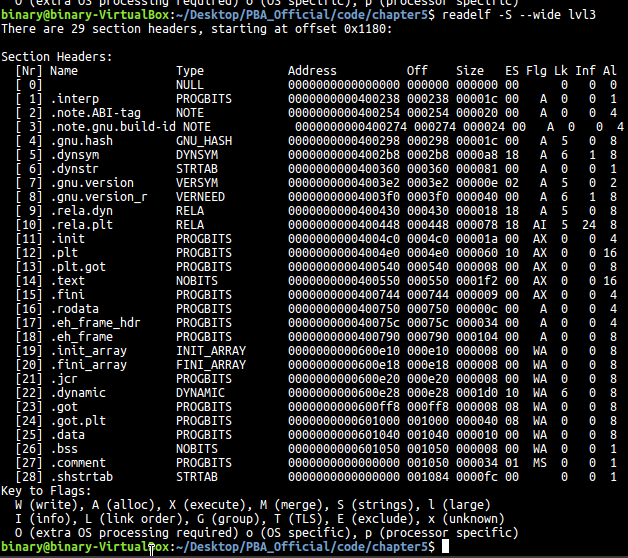
It looks like the .text section has type SHT_NOBITS, which indicates that the section should not contain any bytes in the file. This type is mainly used for uninitialized global data in the .bss section, which doesn’t occupy any space in the ELF file but is created dynamically when the file is loaded into memory. So it appears all we need to do is change SHT_NOBITS to SHT_PROGBITS, or from 8 to 1. We can see that the .text section is at offset 14 in the section header table, so we can simply use e_shoff and e_shentsize to calculate the byte offset to get to the .text section header. Then, we can add 4 bytes to get the sh_type offset into the section header and set it to 1. The final value we need to change is at 0x1504 bytes into the file
1
2
3
4
5
6
7
8
9
10
11
12
typedef struct {
    uint32_t   sh_name;
    uint32_t   sh_type;
    uint64_t   sh_flags;
    Elf64_Addr sh_addr;
    Elf64_Off  sh_offset;
    uint64_t   sh_size;
    uint32_t   sh_link;
    uint32_t   sh_info;
    uint64_t   sh_addralign;
    uint64_t   sh_entsize;
} Elf64_Shdr;
Once we fix this, we can run the binary again to get the true flag:

The final flag for level 3 is